
Choose an Auburn People Directory
No official directory lists every Auburn resident. Government people directories publish work contacts, school directories identify faculty and staff, property and recorded-document indexes tie names to land records, and historical collections preserve earlier residents. Start with the source built for the relationship being checked.
| Directory | Who or what it lists | Keeper | Access |
|---|---|---|---|
| Auburn City Contacts | City staff and service contacts | City of Auburn | Free partial-name or department search |
| Auburn School District | Current faculty and staff | School district | Free filtered directory |
| King County Directory | Employees, groups, and services | King County | Free, three search modes |
| State Employee Directory | Washington agency staff | WA.gov | Free name or agency search |
| Property and deed indexes | Owners, taxpayers, and document parties | King or Pierce County | Free online; older records may be offline |
| Printed city directories | Past residents and businesses | Washington State Library | On-site, selected years |
| Newspapers and yearbooks | Residents, relatives, students, clubs, and businesses | KCLS and White River Valley Museum | Online, microfilm, or request |
A work directory is strongest for reaching an office. A property roll helps trace a taxpayer or parcel. Printed books and local papers are better for a past household. If a county source is involved, check whether the Auburn address falls in King or Pierce County before treating a missing result as final.
Search Auburn City Staff Directory
The Auburn City Contact search accepts part of a person's name or a department choice. It also posts frequently used service contacts, which helps when the employee's name is unknown. Results show public work contact details, not private personnel data.
| City control | Type | Required | Directory behavior |
|---|---|---|---|
| Name | Text | No | Accepts a partial person name. |
| Department | Dropdown | No | Filters to a city department instead of a name. |
| Search | Button | No | Runs the selected name or department query. |
A typical entry can contain a contact or service name, work telephone, department or group context, and a work email when supplied. It does not show a birth date, home address, personal telephone, or staff application. Search a surname fragment, then use the department to distinguish namesakes.
The official Auburn directory interface displays the two-route search.
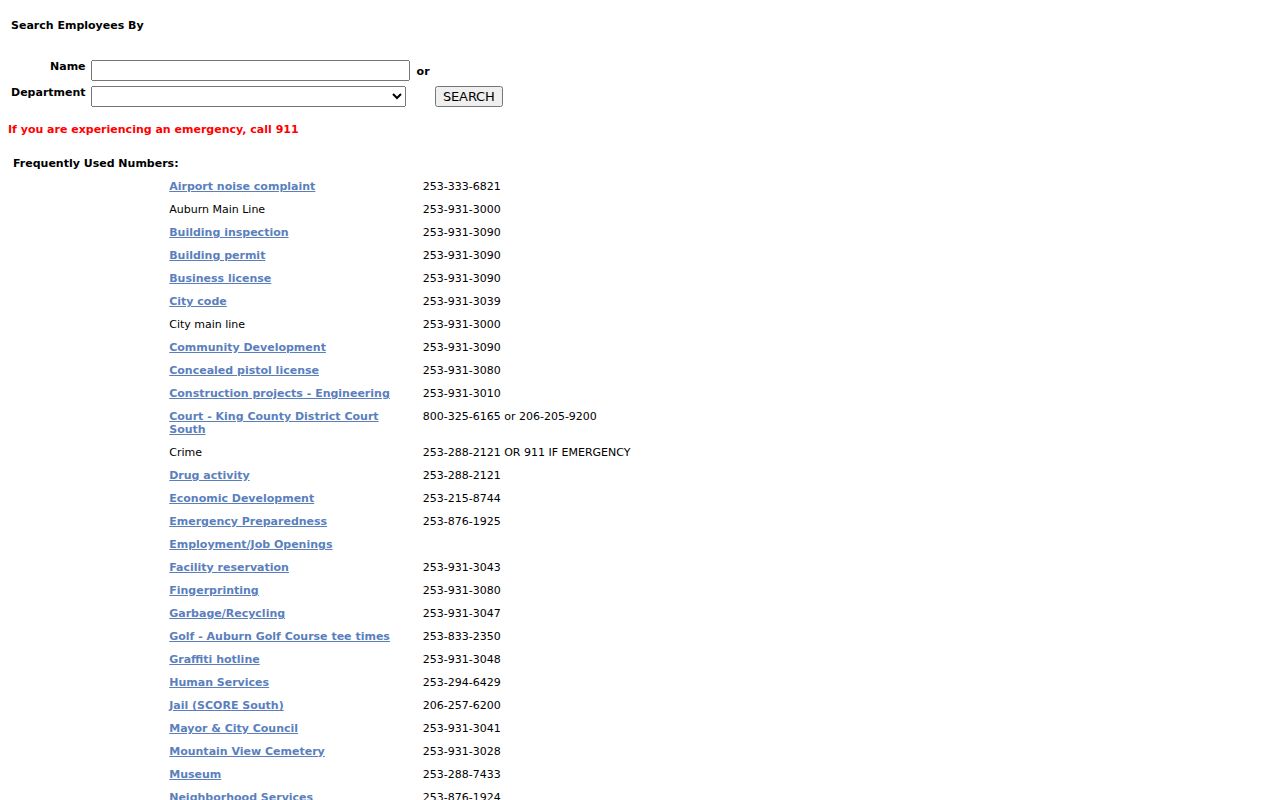
The department selector also supplies a sound fallback when spelling or a preferred name keeps a staff record from matching.
Auburn School Staff Directory
The Auburn School District directory covers faculty and staff across district locations. During the August 2026 inspection, the unfiltered directory displayed 3,278 entries across 274 pages, with 12 entries per page. Filters make that large set much more useful.
| Search controls | Keyword, role, first name, last name, and location. |
|---|---|
| Person fields | Full name and a title when populated. |
| Institution fields | Faculty and Staff role plus a named school or district location. |
| Contact | Work email when published and a View Profile link. |
This is a current institutional directory, not an alumni or student roster. Some entries omit a title or email. When a name fails, select the school and role, or call the school office. The district's searchable people directory shows its location and name controls.
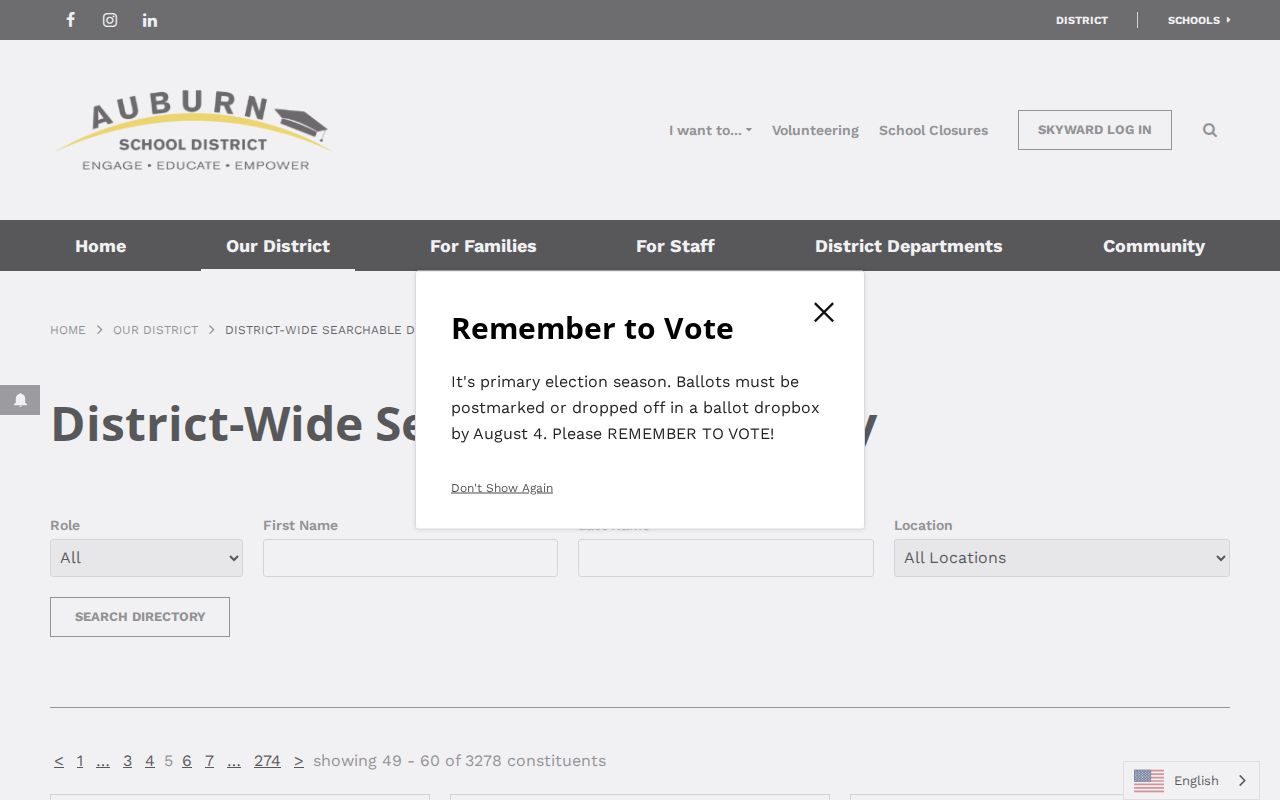
The visible pagination explains why a filtered search is more reliable than scanning the full district list.
Note: The district directory lists staff contacts and must not be described or used as a directory of pupils.
Auburn Government People Directories
City, county, and state directories have separate scopes. The King County directory offers Employee, Group, and Service tabs. A person result typically includes name, title or group, work phone, mail stop or work location, and links within the organization. Pierce County publishes a contact directory and department pages, but research did not confirm one countywide staff-name tool equal to King's.
The King County people directory screen makes its employee, group, and service paths explicit.
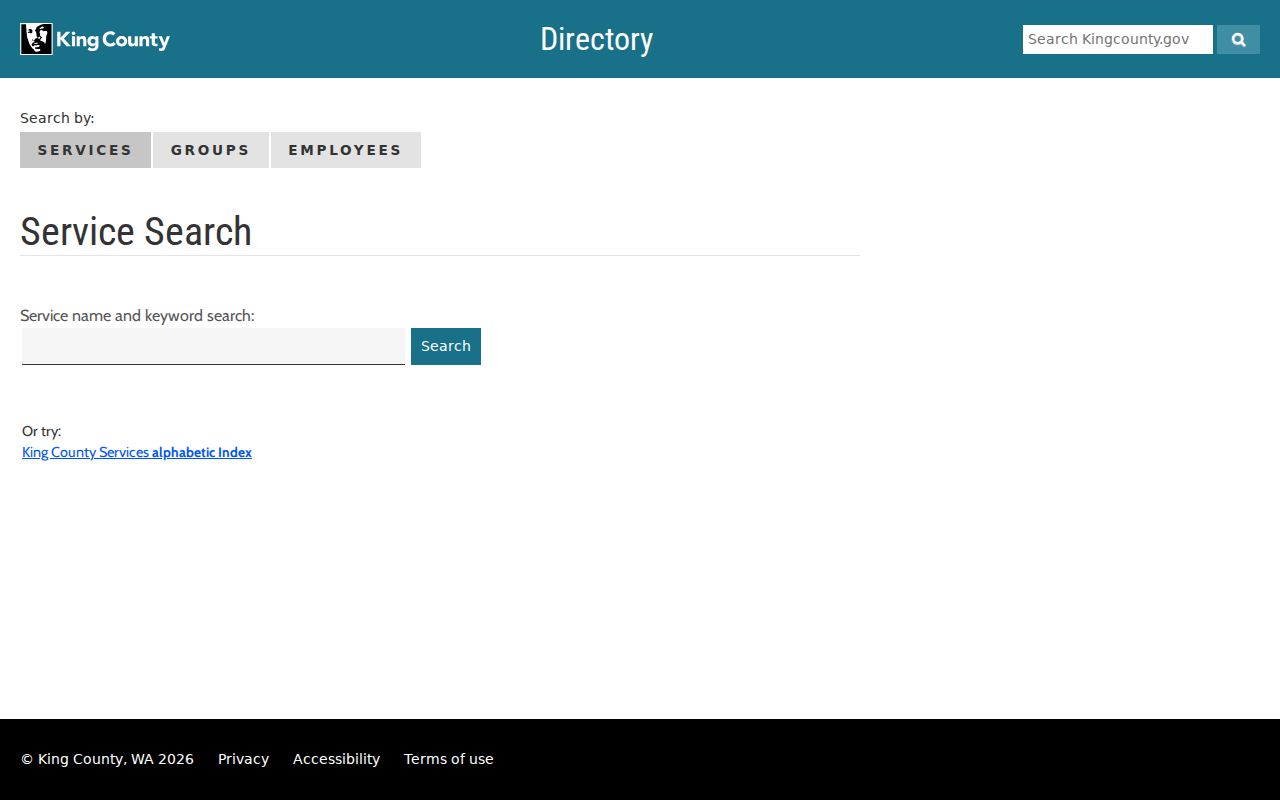
Use the service tab when a public function matters more than a staff surname.
The Washington employee directory searches Last Name, First Name, or Agency. It returns published government work contacts. Private residence, personal telephone and email, identification data, and emergency contacts are not part of the public directory.
The state directory search illustrates the name-or-agency approach.
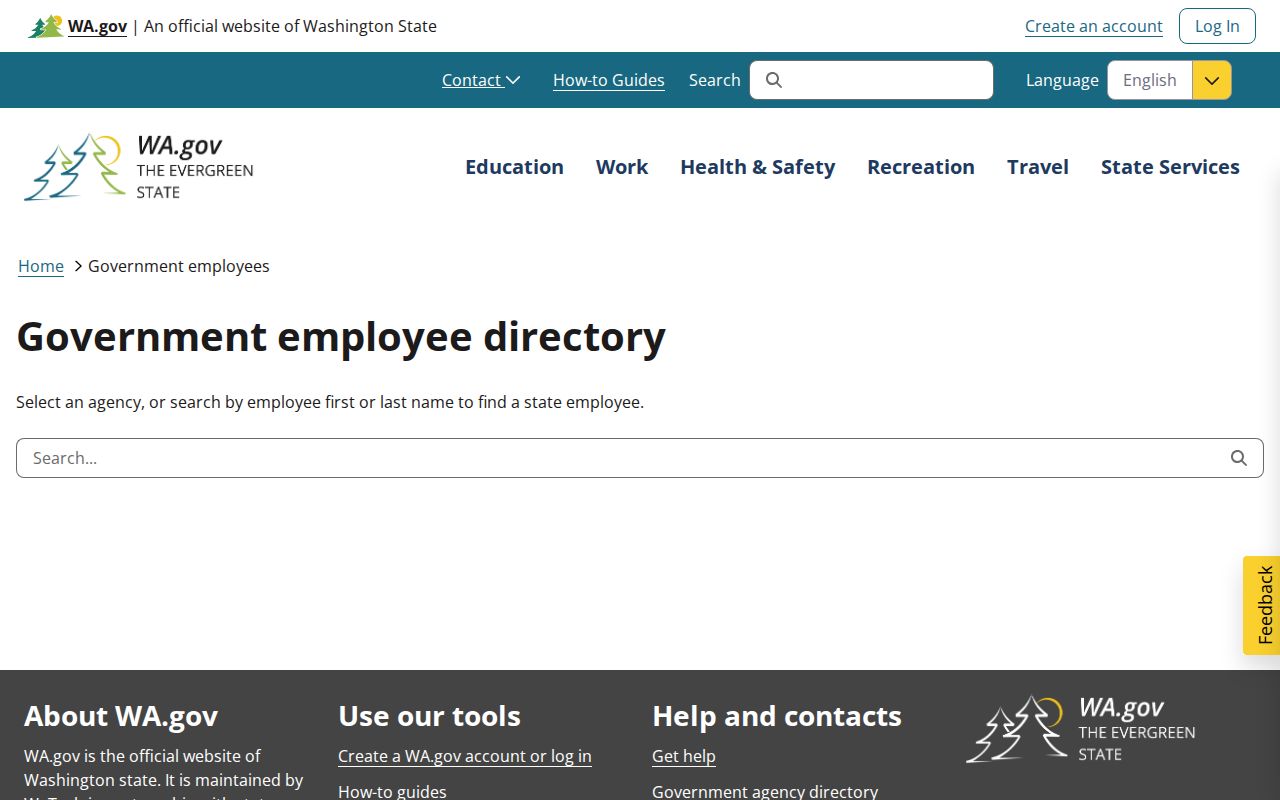
An absent state entry is not proof that a person lacks an agency role because some identities and contacts are lawfully suppressed.
Auburn Property Owner Directories
Property rolls operate like owner directories, but the county changes the search path. Pierce County Assessor-Treasurer supports owner, parcel or account, and address searches. On the King side, the Parcel Viewer and eReal Property route is strongest from an address or parcel. The result can connect an owner or taxpayer name with a parcel, legal description, assessed value, and mailing or situs address.
- Situs
- The physical address assigned to the parcel.
- Taxpayer mailing address
- The place where tax notices go; it may not be the owner's residence.
- Grantor and grantee
- The parties transferring an interest in a recorded document.
- Criss-cross directory
- A directory organized from address to occupant rather than name to address.
Recorder indexes add prior parties. King Landmark supports names and document types, with most documents from August 1, 1991 forward. Pierce provides current and historical recorded-document searches, while some pre-1984 images require office microfilm. An index hit proves that a name appears in an instrument, not that the person still owns or occupies an Auburn address.
Access rules and official-copy routes belong to the separate Auburn public records system.
Auburn Professional Business Directories
Professional and business directories describe different relationships. The Department of Licensing lookup covers regulated fields such as real estate, cosmetology, architecture, and engineering. The Department of Health credential search covers health providers. The Washington State Bar Association maintains its legal directory, while Labor and Industries verifies contractors and trades.
For a local firm, start with Auburn's public business listing, then check the Department of Revenue for its UBI and endorsements. The Secretary of State corporation search can identify a legal entity, governors, registered agent, status, and filings. Use the occupation regulator last to verify the credential tied to the work. A city listing, UBI, corporation record, and professional license each proves a different fact.
Do not equate a directory profile with ownership. Chamber membership is voluntary, a city listing shows local activity, and a state entity record identifies a legal organization.
Historical Auburn People Directories
The Washington State Library city-directory collection holds a broken but useful Auburn run. Volumes labeled Auburn cover 1968-70, 1972-75, and 2000. Auburn also appears within Seattle Suburban South for 1976-83, 1985, 1987, and 1991. These are on-site holdings. Confirm whether a specific physical volume includes a reverse section before planning an address-to-occupant search.
| Era | Directory label | Years held | Likely use |
|---|---|---|---|
| Late 1960s-1970s | Auburn | 1968-70, 1972-75 | Name, address, household, and business context |
| Regional suburban run | Seattle Suburban South | 1976-83, 1985, 1987, 1991 | Auburn entries hidden under a regional title |
| Later standalone book | Auburn | 2000 | Turn-of-century resident and business reference |
This odd title change matters. A catalog search limited to books named “Auburn” skips much of the verified run. Printed entries may contain a spouse, occupation, employer, and street address, while a criss-cross section reverses the route if that edition has one.
Auburn Newspaper Yearbook Directories
Newspapers can serve as a long-running people directory where printed city books leave gaps. The Auburn Library holds microfilm runs from Auburn Argus through Auburn Daily Globe News, spanning 1909-1986 with title changes. The White River Valley Museum newspaper collection adds digitized and physical titles, including the White River Journal, Auburn Reporter, and Muckleshoot Monthly.
A 1914-16 name search should span Argus, Globe, Republican, and Globe-Republican. Obituaries, school lists, legal notices, club columns, and advertisements can connect relatives, organizations, and addresses. Auburn was called Slaughter from incorporation in 1891 until 1893, so both place names belong in early catalog and newspaper searches.
The museum also sells $10 PDF scans of available Auburn High annuals for graduating classes in the 1950-82 range. Not every year is available, and delivery is by email within ten business days. A yearbook supports family-history or classmate research, but it does not establish a current address.
Auburn Directory Gaps Need Archives
The White River Valley Museum is the strongest Auburn-only fallback for names that disappear before digital indexes. Its catalog includes photographs, oral histories, maps, papers, yearbooks, and local newspapers. Physical research is free by appointment with two weeks' notice; staff research costs $25 per hour. The 1909 map of Truitt's Second Addition can help translate an old legal description into a modern parcel.
The Puget Sound Regional Archives serves both King and Pierce County records. Search both county groups because Auburn has no merged county directory. Mountain View Cemetery adds another local name source. It began in 1890 after floods damaged Slaughter Precinct Cemetery and became city-owned in 1946, so early burial records may move among association, county, Slaughter, and Auburn terms.
Community sources preserve people omitted by older landowner-centered directories. Museum oral histories, photographs, and Muckleshoot Monthly can supply chosen names and relationships. Cite them with care, respect rights and cultural limits, and treat catalog names as research leads rather than permission to expose private details.
Note: No authoritative Auburn source confirmed a public master alumni, union, congregation, or funeral-home directory; contact the institution instead of assuming one exists.